 There’s an implicit social contract in most literature classes: the instructor assigns readings, students pretend to do them, when they come to class the instructor pretends they’ve done the reading, and then the instructor proceeds to tell the students all the stuff that he/she feels the students should know about the readings they were never troubled to actually read to start with. Finally, in either a subsequent paper (“Three Reasons Beowulf is an Epic Hero” anyone?) or test (Fill the blank: “Beowulf is an ____ hero” anyone?), students will present as much of what they remember their instructor saying about the readings they never did as a method of showing what they “learned.” And everyone walks away smiling, having achieved another educational learning objective victory.
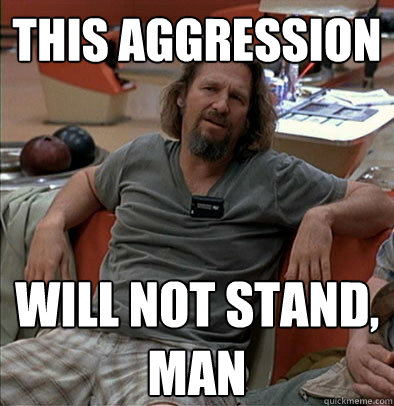
So, as I prepared to teach two sections of Brit lit the first summer session and two sections of American Lit 1865-Present the second summer session, I mentally paraphrased The Dude (or, uh, His Dudeness, or uh, Duder, or El Duderino if you’re not into the whole brevity thing) from The Big Lebowski:
This mediocrity will not stand, man.
I consciously decided to do some things in the Brit lit class the first summer session designed to make students actually read the assigned texts and have something to say about them before they came to class: epic online quizzes on the readings the night before in-class discussions, class papers over readings before we discussed them in class, and my lectures consisting of selected quotes/excepts from the texts I’d present to the class before launching off into open-ended discussion questions.
Results were mixed at best and things limped along from week to week. I wasn’t particularly happy with the level of non-discussion in class. My students, in response, (and despite the “no smartphones in class” rule) surreptitiously stabbed at phones under their desks, made half-hearted attempts to sit upright throughout most of the class, or openly worked on homework for other classes during the two hours we met. That is to say, despite my best efforts, the classes quickly turned into a mind-numbing slog for all concerned.
Then again, I tried to console myself by remembering I’d tried to do some things differently. And, sure, they hadn’t had much of a net positive effect. But maybe, I tried to tell myself, that was just the name of the game. None of my students were English majors and none of the them had taken the class as an elective. Maybe this was the best anybody could do. Maybe a big mental shrug with the unending mantra “But I tried!” was the best response. Just go with the flow, dude: Don’t expect them to read, just tell them fun stories about what they didn’t read, and test them solely on how much attention they may have been paying to what you were saying.
Finally, though, things came to a head the last week and a half of the first summer session.
First, when it came time to discuss Richard III, I read the opening lines—“Now is the winter of our discontent made glorious summer by this sun of York”—and I asked one of my sleepers to awake long enough to tell us what the winter of discontent RIII was referring to. He gave me a look containing multitudes that said, “Not only do I not know, I don’t care that I don’t know, and I don’t care that you know that I don’t know and don’t care” and followed that up by actually saying, “I dunno” and, in conclusion, put his head back down on his desk So, yes, it was apparent even my most basic expectation for them having a handle on the cultural/historical context was going up in flames around me. Fire bad! Big flames! Fire burn!
Second, in another section, I had three students who sat on the next to last row and had to be regularly called out for stabbing at their phones under their desks. The day came where I told the first one to knock it off. Ten minutes later I ha-ha told the second one to stop as well . . . after all, we were so close to the end of the class and I wanted to make it all the way without kicking anyone out of class as per syllabus guidelines about no phone stabbing. So, yes, of course, five minutes after that, #3 cranked up on the phone stabbing and in my full-on teacher voice said, “Okay, sir, you are done for the day. Get out. Get out right now. And feel free not to come back until you’re ready to be engaged with what’s going on in the class.” That was an uncomfortable moment . . . for that guy. He slowly gathered up his homework he’d been working on and slunk out of class.
(After class one of my front-row students said, “I’ve never seen you get mad before.” And so I informed he: “You still haven’t seen me get mad . . . because if I’d been mad you’d have heard an unending trashcan of obscenities pouring out of my mouth for about five minutes . . . which didn’t happen.” Her mouth made a voiceless O.)
The pièce de résistance, however, was on the last day of class as we closed out the “discussion” over the final text on the reading list: Virginia Woolf’s Mrs. Dalloway. I asked the rhetorical question “Does anyone have any final questions, comments, complaints, or demands about Woolf or her novel?” as the lead-in to the “Free at last, free at last, thank God Almighty we are free at last!” end-of-class summation when another of my front-row students raised his hand.
And this is what he had to say:
“What’s up with Virginia Woolf? What’s up with this anthology? Why does everything we read have to make me feel worse when I’m done reading it? Where’s the stuff that’s supposed to make me feel better? Virginia Woolf? Are you kidding me? It’s loser depressing people doing loser depressing things until they die loser depressing deaths. She killed herself in ’41? Well, she should have by God filled up her coat pockets with rocks and walked into a river in ’24 because then none of us would have had to suffer through Mrs. Dalloway. Where’s the C.S. Lewis? All he did was broadcast the lectures on the radio that would become Mere Christianity during the London Blitz in World War II. But oh hell no, we’ll have none of that in the anthology. Nothing from anybody who tried to make the world a better place. Oh no, instead we get somebody so afraid of the Nazis—ooh ooh ooh it’s all about me!!!!—that she had to kill herself instead of doing something anything for anyone else. I’ve had it. I’ve had it up to here! SHE. MAKES. ME. SICK!!!!!!”
And I’m like, okay, so this is the first interesting thing I’ve heard all summer.
Game on, dude.
Follow @markroylong Mark Roy Long
My wife, Kathy says that’s how she felt about Albert Camus!
LikeLiked by 1 person